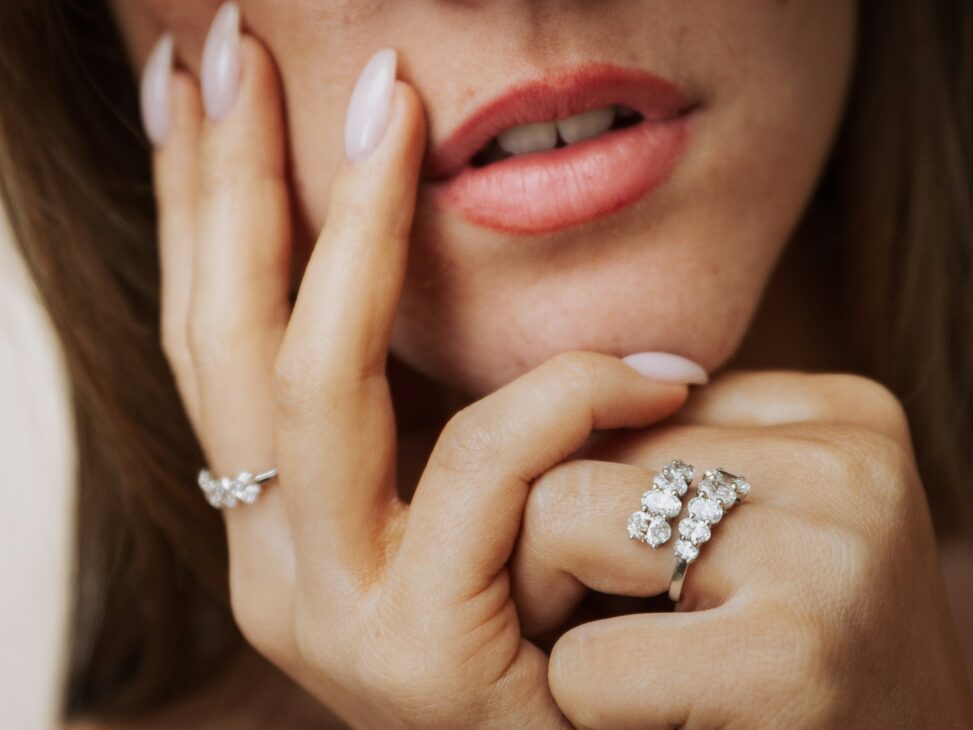
All you need to know before buying diamond eternity rings: mounting, quality and comfort
Two diamond eternity rings will photograph the same way in a product shot but the way the stones are held, how close they match and how the band feels after a full day of wearing it will be different. A photograph can never show you how a claw will snag on a jumper or how the inside of the band will feel when it’s warm.
Which setting suits the way you’ll actually wear it?
The claws of a claw-set eternity ring will snag on hair, clothes, gloves inevitably, as the claws project a little above the band. The advantage of claw-setting is elevation: stones perched on a claw or on shared claws catching two adjacent diamonds concurrently, reflect more light from more directions than stones set flush with the metal.
The way round. The ring is set with the diamonds between two walls of metal, so it will sit low and is more inclined to the wearer who types, lifts, or uses their hands a lot – at the expense of a little less light getting through the sides.
Grain settings, also known as bead settings, secure each stone with little beads of metal and provide a silky, sparkling band. Those beads are so fine that they’re worth having checked at your regular service visits.
How high you wear it on the finger will also influence how your band will sit next to your ring. A high claw-set row may snag on a ring next to it, where as a channel-set row will sit closer to the finger, and so will feel quite different to wear with your ring.
Do the diamonds need to go all the way around the finger?
Another style of eternity ring wraps stones all the way around the band for the classic look from all angles. The stones on the palm side have more contact in daily life, than the top ones for example bag handles, steering wheels and gym equipment.
A half eternity ring retains the diamonds on the visible top part of the ring and has a band at the back that is plain metal. This is more comfortable for anyone who uses their hands a lot, lifting or grabbing, and the plain band at the back makes it simpler to wear next to other rings.
Where they vary most is in sizing. A full eternity is much more difficult to re-size later than a half ring; if you know the right size, buy full eternity. A full ring is more often worn as the only ring, while a half is better for stacking.
The easiest way to get a feel for the stones is to try on a selection of diamond eternity rings in half and full styles on your own hand.
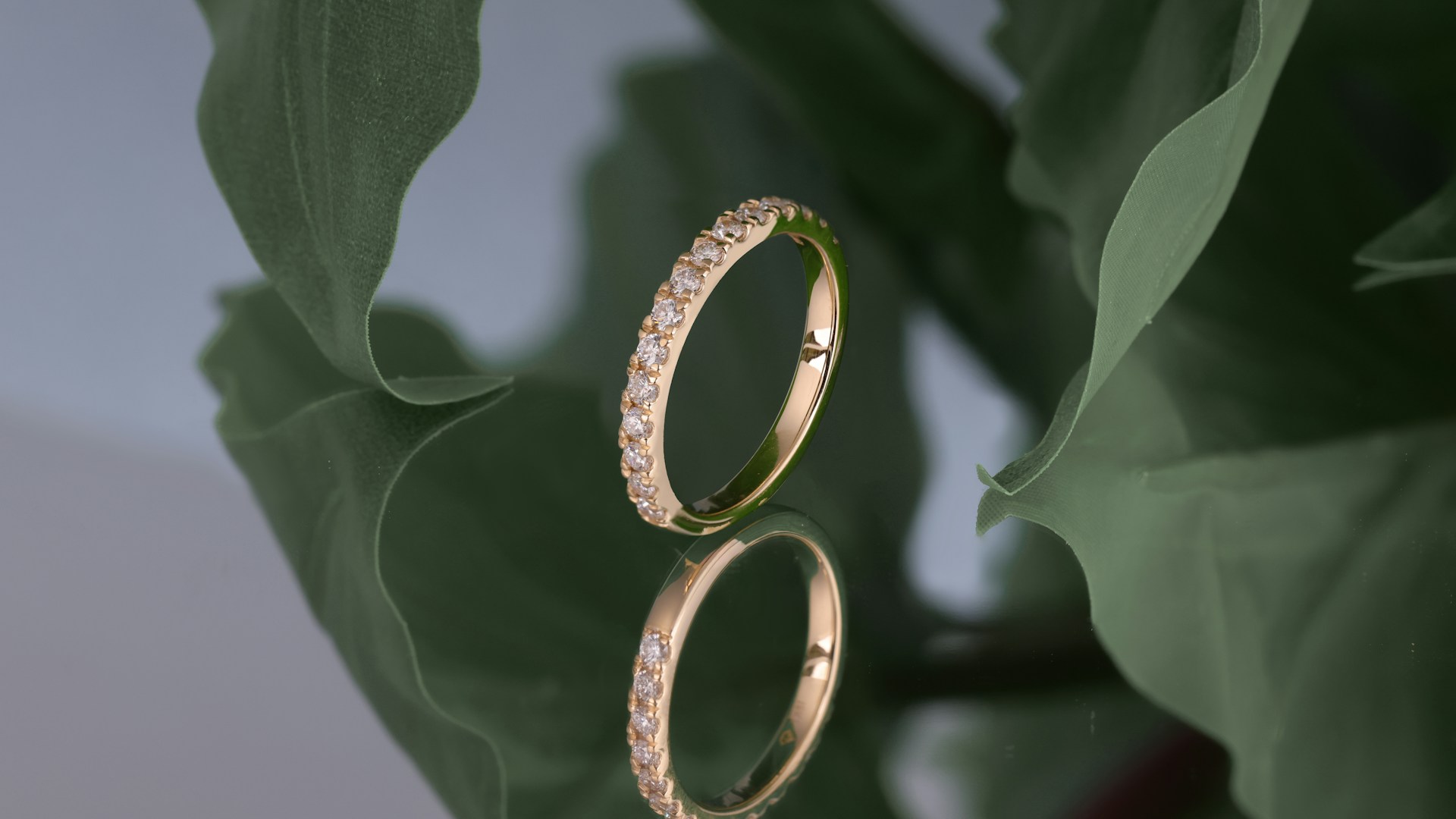
What makes the diamonds in an eternity ring good quality?
Matching is everything: a high quality eternity ring will have stones that are near-identical in colour, clarity, cut and size so that no one stone draws your eye away from the string of stones. Among twenty or thirty stones, one warmer or duller stone pops out like a sore thumb more than it would in a solitaire.
Colour and clarity can be deceiving at small sizes. Small inclusions aren’t visible face-up in a small stone but the tiniest colour variation is apparent when stones are viewed side-by-side, which means the colour consistency of the whole row of stones counts more than the grade of a single stone.
Cut determines the sparkle of the ring. A well-cut stone will make the ring sparkle when it moves; a badly cut stone will have dull patches that glint when you tilt the ring.
Uneven stone heights or poor sitting creating edges that snag on fabric and appears uneven on the side. Tilt the ring and look down the row.
Certification must be answered differently. Small stones in a band are not usually graded individually but as part of a matched parcel – so ask where the stones came from, how they were graded and matched, and if you can examine the ring under a magnifying glass.
The metal below also counts. If the band is thin beneath a whole row of stones, it is more likely to bend or weaken more quickly, so consider the thickness of the band behind the diamonds. In the UK, platinum and gold jewellery above small weight limits should be stamped with a hallmark featuring the maker’s or sponsor’s mark, metal and purity, and the assay office.
How do you know it will feel good in your hand?
Inside shape is what everyone sees first when they walk into your showroom and last thing at night. An inside that’s comfortably shaped will be much kinder to a finger than a flat one when your fingers throb after a day in the heat.
Both width and depth are important. An extra-wide band with bigger stones may encroach on the adjacent finger or be too chunky to fist comfortably.
Test some simple daily motions with the ring: typing, gripping a handle on a bag, turning the wheel of a car. It might feel okay when stationary, but the moment your hand moves the ring can dig into your finger or catch.
Try the ring at various times of day if you can, as fingers tend to swell when it is hot and/or later in the day. This is especially relevant to a full eternity ring which is all too difficult to resize. And observe how it sits next to your engagement ring or wedding ring.
What questions to ask / enquire before you make a purchase?
Begin with the construction. Inquire about the setting, how the stones are held in place and how frequently your claws or beads need to be checked for wear and tear.
Next, inquire about the ring’s future:
• To what extent can it be resized, repaired or re-tipped in the future, and how would that impact this style?
• Can the jeweller make a ring to match another ring you already have?
• Does this come in your size, or is it to be ordered?
Both photos show similar rings, but the stones match differently and they are different thicknesses. Never just look at pictures; compare the rings side by side in good light.
If you have two rings, try them both on when your fingers are at their biggest at the end of the day before you make your decision.