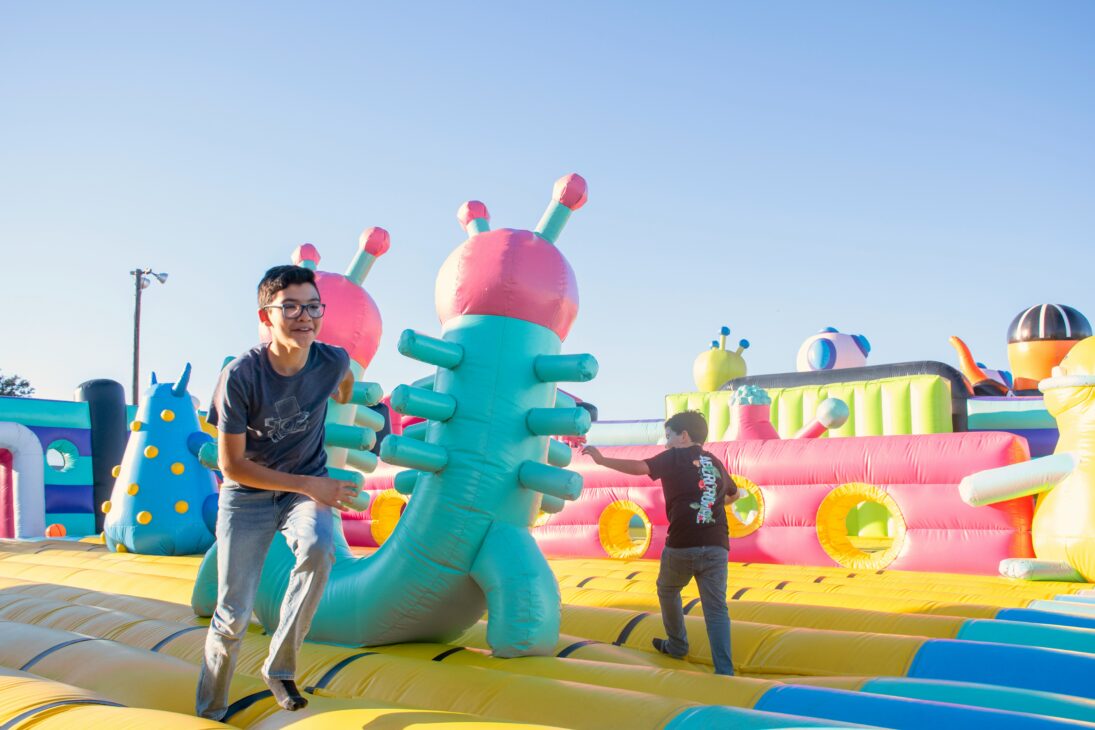
How Many Sections Should an Inflatable Obstacle Course Have?
Inflatable Obstacle Course Sections: How many sections should an inflatable obstacle course have? For school sports days and children’s parties, three to five sections is usually enough. For corporate events and festivals, six to ten sections gives participants a longer, more challenging run.
Imagine a school booking with 180 children and one afternoon to get everyone through. You need a course that keeps the queue moving, fits the venue and doesn’t take hours to set up. Section count affects all of that, along with your costs, crew and power requirements.
Three to Five Sections Suits School and Children’s Bookings
First, it’s worth knowing the difference between a section and a part. A section is an individual obstacle, such as a crawl tunnel, climbing wall, pop-ups or slide exit. A part is a separate inflated unit with its own blower. A two-part course might have six sections, while a single-piece unit could contain four.
For school sports days, children’s parties and summer fairs, three to five sections is the range most operators work with. Shorter runs mean quicker turnarounds, which matters when you have got a queue of excited children waiting. A compact inflatable assault course with two lanes can run heats side by side, getting a class of 30 through in around ten minutes.
A longer course might look impressive, but it is not always the best choice for children’s events. What matters is how many people you can get through safely. Check the user height limits on the inspection tag too, as these determine which year groups can use the equipment.
Six to Ten Sections for Adult, Corporate and Festival Work
Corporate fun days, team-building events and festivals often need something more substantial. Six to ten sections gives adults a proper challenge, makes timed heats more entertaining and creates the visual impact clients expect. Just make sure any adult inflatable obstacle course has the correct user height rating before quoting.
Look at the overall length as well as the section count. A long course with widely spaced obstacles can feel slower than a shorter one with challenges closer together. The layout matters just as much as the number of sections.
Browsing Airquee’s obstacle course range lets you compare commercial-grade courses by length, section count and user rating. Airquee is a UK manufacturer that builds its inflatables, including bespoke courses for larger events. Its UK courses are PIPA tested and built to BS EN 14960 Standard, although certification should be checked for each unit. Led by people who previously ran one of the UK’s largest inflatable hire companies, Airquee also manufactures bouncy castles, slides and games, giving operators consistent specifications and one contact point for repairs.
Commercial Courses Need More Sections Than Domestic Ones
Domestic obstacle courses usually have one or two obstacles, lighter fabric and a smaller blower. They’re designed for family use, not regular transport, repeated set-ups or paid hire. A domestic assault course inflatable bought online might cost less, but it isn’t built for the demands of a hire business.
Commercial-grade courses use heavier PVC, generally have more sections and are built to BS EN 14960-1:2019, the British and European standard for inflatable play equipment. HSE guidance advises operators to check that equipment meets this standard and carries a valid PIPA or ADIPS tag.
Certification is specific to each product, so always request the paperwork for the exact course you’re buying. For a hire business, commercial-grade equipment is the only sensible choice.
Match the Section Count to Your Space, Crew and Power
More sections mean a bigger course, but also more work on the day. Before ordering, think about the venues you regularly visit. A large inflatable assault course might suit a festival field but prove difficult to manage at a school with narrow access.
Check these four things:
- Footprint: Measure the full course length and allow for the required clear safety zone. Plan around your smallest regular venue.
- Power: Each inflated part needs its own blower. A three-part course requires three blowers, three leads and enough electrical capacity.
- Crew: Two people can often manage a small single-piece course. Larger multi-part builds need more staff and set-up time.
- Transport and storage: Modular courses split into lighter parts that are easier to move and store. Single-piece units have fewer connections but require more lifting.
If most bookings are schools with limited access, a modular course with four or five sections often offers the best balance. Corporate-heavy diaries can justify longer builds, as those venues tend to provide more space and set-up time.
Every Extra Section Adds Cost and Upkeep
Each additional section adds fabric, seams and baffles, sometimes requiring another blower. That increases the purchase price, so ask manufacturers to quote for different lengths before deciding. Work out how many extra bookings you would need to cover the difference.
Think about whether a longer course would help you secure corporate work you couldn’t take before. If it won’t bring in more bookings or better hire fees, a shorter course may offer better value.
More seams also create more potential wear points. Choose a supplier that can repair and retest its equipment, and check lead times before ordering. Bespoke courses take longer than stock units, so allow enough time before the busy season.
Choose Your Section Count, Then Check the Spec With a Manufacturer
The right section count comes down to the bookings you want. Use this table as a starting point:
| Booking type | Sections | What matters most |
| School sports days, children’s parties | 3 to 5 | Quick turnaround, people per hour |
| Corporate days, festivals | 6 to 10 | Timed heats, length, visual impact |
| Mixed diary | 4 to 6, modular | Flexibility across venues |
Once you have chosen a range, ask the manufacturer for the dimensions, user height limits, blower count, certification and lead time. Buying castles and courses from one supplier can also help keep specifications consistent and make repairs easier to arrange.
Order well before your busiest months so your course arrives tested, tagged and ready for hire.
FAQs
Can I add sections to an obstacle course later?
Some modular courses can take additional parts, but only if the manufacturer designed them for expansion. Adding sections changes the layout and may require another inspection, so always check first.
Is a domestic obstacle course OK for hire?
No. Domestic courses aren’t built to the commercial standard for paid public use, and insurers are unlikely to cover them. Choose a commercial-grade unit with a valid inspection tag.
How many people per hour can a six-section course take?
A two-lane course with 45-second runs could theoretically handle around 160 people per hour. Divide 60 minutes by the run time, then multiply by the number of lanes. Briefings, resets and breaks will reduce the actual throughput.