How PackTHC Helps Small Cannabis Brands Build Shelf Presence
A dispensary shelf gives a new brand about two seconds. A shopper scanning a case of flower sees caps, colors and labels before reading a single strain name, and the brands with the biggest budgets usually own that at first glance. They print custom containers by the hundred thousand and pay agencies to design them.
Small brands can’t do that. What they can control is the container itself. Size, color and label matter, but what matters more is whether all of it looks the same every time a budtender pulls a unit off the shelf. A packaging supplier has more say in this than most founders expect, and it’s the part of the business PackTHC’s product range is set up for.
Shelf presence starts with consistency
Big brands look big mostly because they look consistent. Every eighth sits in the same container with the same cap color and the label in the same spot. A shopper who bought once recognizes the product the second time without reading anything.
Small brands often lose this by accident. They buy whatever vials are cheapest that month, switch suppliers when stock runs out, and end up with three slightly different containers on one shelf. To a customer, that reads as a product nobody is managing.
The fix is boring: pick a container and keep buying the same one. PackTHC stocks its pop top vials in fixed sizes (6, 13, 19, 30, 60 and 90 dram) and a standard color set of clear, black, white, green, gold, silver and blue, with some sizes also sold in red, purple or smoke. Because these are stock items and not one-off production runs, a brand can reorder in month eight the exact container it launched with in month one.
Using color to sort a product line
Color is the cheapest branding tool a small company has. It costs nothing extra on a stock order, and it does work from six feet away that a label can’t.
Ways brands use it:
- One cap color across the whole line, so every SKU reads as the same brand.
- A different color per strain type, such as green for indica and gold for sativa.
- A clear body for premium flower so the buds do the selling, with black or white for budget tiers.
- A one-off color for a limited or seasonal release.
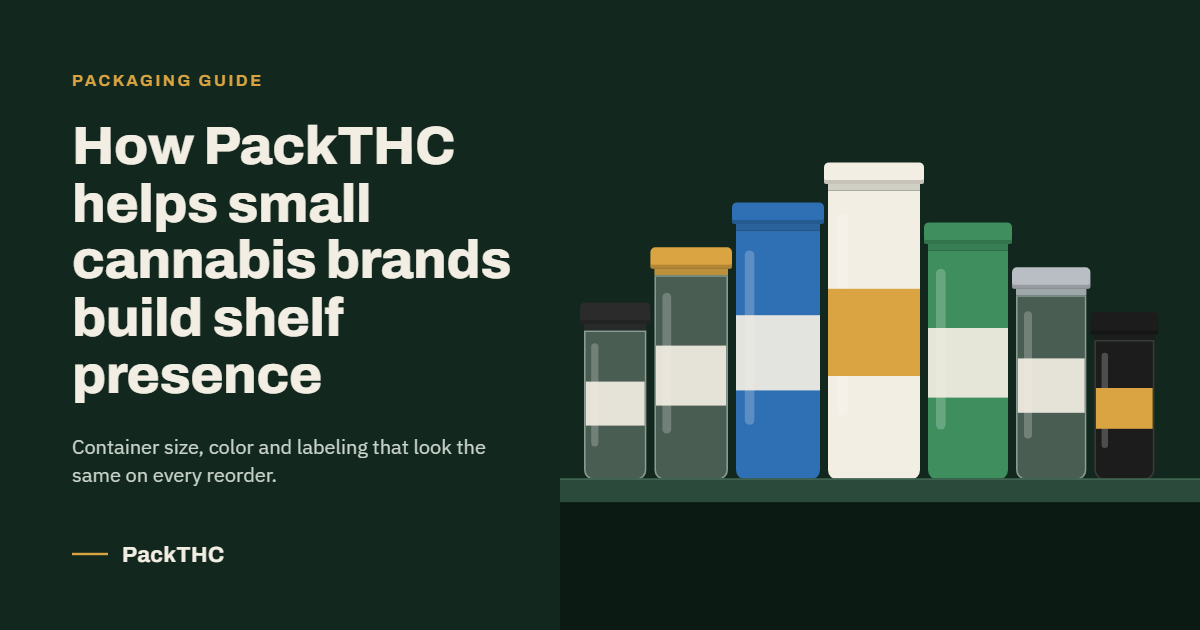
The clear-body approach works because shoppers want to see what they’re buying. A clear vial with a gold or silver cap looks more expensive than it is, and on PackTHC’s 6 dram bulk case the unit price is a few cents per vial.
Sizing that matches the product
A vial that’s too big makes a gram look like a mistake. One that’s too small gets overfilled, won’t close properly and crushes the flower. Either way the product looks worse than it is.
PackTHC lists its larger vials by weight as well as dram: 19 dram for an eighth, 30 dram for a quarter and 60 dram for a half ounce. The 6 and 13 dram sizes suit single grams and pre-rolls, while the 90 dram size covers bigger flower purchases and bundles. For brands unsure which size fits their fill weight, the site has a packaging size calculator.
Matching size to weight sounds minor. On a shelf, a full container next to a half-empty one makes the full one look like the better deal at the same price.
Compliance without the guesswork
No amount of branding helps if a dispensary rejects the product at intake. Most U.S. adult-use markets require child-resistant packaging, and buyers check.
PackTHC’s child-resistant pop top vials use a squeeze-to-open cap built to meet the federal Poison Prevention Packaging Act standard that most state cannabis rules start from. That covers the federal baseline. Several states add their own rules on labeling, opacity or resealability, so brands still need to check their state’s requirements before ordering. PackTHC says this on its own product pages, which is more honest than the “compliant everywhere” claims some suppliers make.
For a small brand, it means one less thing to source separately. The container that carries the branding also handles the child-resistant requirement.
Labels and custom branding
Stock containers get a brand most of the way. Labels do the rest.
Pop top vials have a smooth, rounded surface that takes a wraparound label cleanly, which is why so many brands start with them. A brand with a handful of SKUs can print labels in-house or through a local printer and apply them to stock vials, keeping spend low while the product line is still changing.
Once volume grows, PackTHC offers custom labels, private label packaging and custom printing through a quote request. Printing holds up better than paper labels through handling and shipping, and it’s the point where a small brand’s packaging starts to look like a big brand’s. PackTHC offers custom branding on larger orders, so most brands reach this stage after a few successful reorders, not at launch.
Buying in amounts a small brand can afford
Bulk pricing doesn’t help if the minimum order ties up a month of cash. PackTHC sells its pop top vials in case quantities that scale with size: 600 per case for 6 dram, 160 for 30 dram and 45 for 90 dram. Pricing is tiered, so unit cost drops as order size rises, and the company runs a price match policy on identical products.
Order the sample kit first. It costs $19.99 in shipping, includes pop top vials along with pre-roll tubes, jars and mylar bags, and the shipping cost comes back as store credit on the first bulk order. A founder choosing between three cap colors will settle the question faster by holding the containers next to the actual product than by looking at photos.
PackTHC ships from locations in New York, Texas, Florida, Michigan and California, which shortens transit for brands in those regions.
Beyond vials
Few small brands stay single-format for long. Pre-rolls follow flower, and concentrates often follow pre-rolls. Buying everything from one supplier keeps colors and finishes matched, so the flower vials and pre-roll tubes look like they belong to the same brand when they sit side by side.
PackTHC carries pre-roll tubes from 78mm to 116mm, including a Made in USA pop top tube line, plus glass jars, mylar bags, concentrate jars and Chubby Gorilla containers. The company lists more than 2,500 child-resistant SKUs and says it supplies over 1,500 dispensaries.
Where to start
For a brand launching its first flower SKUs, a practical first order looks like this: get the sample kit, pick one vial size per fill weight, choose one cap color for the whole line (or one per strain type), and print a simple label. Reorder the same containers every time. Move to custom printing once the line settles and volume justifies it.
None of this takes a large budget. It takes the same container and label on every unit, and a supplier that keeps both in stock.